
Listeria: Another Reason Why You Should Not Drink Hot Dog Juice

The bacteria Listeria has a special place in my heart--not to imply that I don't love all bacteria in their own special way. Listeria is in the headlines again with the national recall of Blue Bell products being announced after 10 cases of listeriosis were reported in 4 states, 3 of which were fatal.

Though listeria has only a small slice (~1%) of the total food-borne illness burden, it does claim a substantial proportion (~20%) of food borne deaths granting it a special status. This is really a ubiquitous bacteria that is present in herd animals and the soil. It can contaminate soft cheeses, hot dogs, deli meats, cantaloupes and other products. The immunocompromised, pregnant, and newly born are at particular risk for severe infection.

What makes it so deadly is its ability to move from the GI tract to the blood and then to other organs. One place where it is particularly damaging is in the central nervous system. Listeria meningitis and encephalitis have particularly high mortality rates.

The best means to prevent listeria are safe food handling procedures (i.e. avoid hot dog "juice" exposure) and for those at particularly high risk to avoid eating foods that may be contaminated with listeria. There is also an innovative product (ListShield) containing viruses that attack listeria (bacteriophages) that can be sprayed directly onto food to kill the bacteria.

So why does listeria have a special place in my heart? It's not its actin "jets" (so cool) or tumbling motility (really endearing to watch). It is because as a operating room volunteer in the mid-1990s applying to medical school, I knew I wanted to be an infectious disease physician. When I was done volunteering, I would roam over to the infectious disease division and poke around looking for real life infectious disease physicians and researchers. One day, I stumbled upon a researcher (who has long since left my institution) who worked on listeria and he explained its microbiology and disease-causing attributes to me with such passion, I'll never forget the incident and the time he took to indulge my interest in infectious disease.
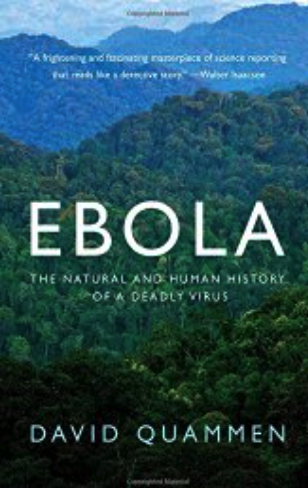


Viral Ecology Explained: A Review of David Quammen's Ebola

As I've written before one of the most fascinating aspects of infectious diseases to me is the fact that an infection is an intricate interplay between a host, a microorganism, the surrounding environment and, in many cases, a vector (e.g. an insect) or a reservoir species (e.g. bats). The concept viral ecology is often used to capture this interaction. 

Ebola is a paradigmatic disease that encompasses all of the above. With Ebola Virus Disease you have humans getting infected in specific geographic regions after some sort of contact with an as yet discovered reservoir species or an intermediate host such as an ape.  

David Quammen's Ebola: The Natural and Human History of a Deadly Virus, released last fall, is a great guide to the viral ecology of Ebola. The book is an expansion of an extracted portion of his 2012 tour de force Spillover.  

What Mr. Quammen does in this short book is masterfullyweave together the various threads of Ebola research that began in 1976 when its first outbreaks were recognized. Covering such topics such as the geography of Ebola outbreaks, the search for reservoir hosts, the impact on the gorilla population, and--my particular favorite aspect--why/when/where Ebola outbreaks occur. The book also contains a valuable epilogue that places the current West African Ebola epidemic in context--an essential requirement for understanding how this outbreak exploded to its current unprecedented stature.

Mr. Quammen is a gifted story teller and his treatment of infectious diseases is unrivaled. I am eagerly looking forward to reading and learning from his latest book The Chimp and the River, which is focused on arguably the most prolific infectious disease killer: HIV.

When Urgent Care Centers Meet Infectious Disease Emergencies

The rise of urgent care seems to be very rapid and has now opened up a third option in medicine to supplement physician's offices and hospital-based emergency departments. Such access is welcomed as it is convenient, free of the hassle of waiting rooms, and incurs less cost. Broadly speaking, I classify the nation's 9000 urgent care centers into two types: hospital-owned or hospital-independent. About three quarters of urgent care centers are not owned by hospitals and about half of the physicians who work in such center are specialists in Family Medicine. 

With 96% of cases not requiring the patient to be directed to an emergency department, it appears that a niche is being filled--especially for minor orthopedic ailments and wound care. However, in my biased infectious disease and disaster medicine worldview (as well as a board-certified emergency medicine physician and fellow of the American College of Emergency Physicians), I have a few concerns regarding urgent care centers that arise in a specific context.

No urgent care center is a substitute for an emergency department but there is, in my experience, a clear variation in operations between hospital and non-hospital affiliated centers. One specific concern that applies to non-hospital based urgent care centers is the degree of their integration into the public health communicable disease infrastructure in their locality. During outbreaks of important diseases widespread 2-way communication occurs between public health authorities and hospitals that urgent care centers--when not affiliated with a hospital--may never hear especially if staffed with locum physicians who may not even know which county they are practicing in, let alone the local epidemiology.

Recently, in a Pittsburgh suburb a non-hospital affiliated urgent care center not only gave a patient an erroneous diagnosis of measles--a public health emergency--but failed to order the appropriate confirmatory test, notify public health authorities, or perform any sort of infection control procedure. Thankfully the patient was clearly not a case of measles and no delayed contact-tracing had to performed, but that didn't prevent a social media panic from ensuing when the patient's father posted the false diagnosis, he had every reason to believe accurate, on Facebook. Were this an urgent care center affiliated with a hospital, numerous red flags would have tripped and hospital infection control would have been involved the moment the word "measles" was mentioned.

I wonder how many other infectious diseases of consequence may slip through the cracks in situations much like this (I'll save my rants on the poor antibiotic stewardship that occurs in urgent care centers for another time).

A solution to this shortcoming  is to embrace urgent care centers in health care emergency coalitions. Health care coalitions are largely hospital based but have increasingly began to involve entities from other realms of healthcare. Not only do such coalitions plan for infectious disease emergencies jointly, they adopt an integrated all-hazards approach that makes a community more resilient to a whole host of threats including weather emergencies and mass casualty accidents. As many hospital-independent urgent care centers are multi-state I estimate, and from research my colleagues and are conducting, not many are incorporated into hospital coalitions--a situation that is clearly suboptimal and, in a public health emergency, dangerous. 


Measles in a More Rational Bygone Era

For those who brush off a disease such as measles, that hospitalizes 1 in 4, as no big deal because it was a routine illness pre-vaccine I recommend watching a specific episode of the 3rd season television series Lark Rise to Candleford, which aired on the BBC from 2008-2011. 

This series catalogs the daily comings and goings of two towns in turn-of-the-century England, one of which is rural. Stories center on various aspects of daily life and are thoroughly interesting. One episode I recently watched brought up the issue of what measles could mean to a rural community in that era and it was devastating. 

Cases begin within a trickle and then an onslaught, reflecting the sheer power of this contagion to infect a naive population. Many townsfolk recounted prior bouts of measles which made children "fodder for the epidemics" and thinned families as not every case is uncomplicated. One character, who runs a post office out of her home and is caring for a sick child in the household, astutely moves activities to an alternate site. She matter of factly states she would not have the post office, which is the social focal point of the town, be exploited by the virus as a source of new victims.

One point which is heavily emphasized is the burden sick children place on caregivers as this incident occurs during harvest season when all hands must be on deck in order to have food for the winter. While this is an obvious issue in an agrarian population in the late 1800s, it is still a very instrumental fact today as is evident when a child gets sick and often requires a parent to take time away from productive endeavors until the child convalesces. The caregivers of children with influenza, for example, miss an average of 73 work hours.  

In the 4 current US measles outbreaks that have occurred thus far this year, there is no doubt that each of the children afflicted rightly requires special care from their parents--hospitalized or not--and such a requirement has ripple effects. This phenomenon, often overlooked, is another example of the life-enhancing aspect of vaccines as they not only diminish the burden of disease but minimize the impact on those who are not directly infected.

This crucial fact was grasped by the human race in a more rational era when vaccines against many childhood illnesses had not been developed and the toll of these scourges was a threat from which no one could escape.


Methyl Bromide: Not an Ideal Caribbean Sea Breeze Component

The news that a Delaware family vacationing on the island of St. John, part of the US Virgin Islands, were exposed to toxic amounts of the pesticide methyl bromide in their rental villa has raised important questions as to the circumstances of this exposure and what it means from a public health standpoint. From news reports, it appears that the exposures emanated from an apartment below their villa and were significant with all 4 family members severely poisoned with symptoms such as seizures and loss of consciousness occurring; 3 of the 4 members required mechanical ventilation.

Several points to keep in mind are:

  • It is primarily used as a fumigant and is odorless--making it hard to know one has been exposed
  • The route of exposure in humans is usually via inhalation
  • It has many toxic effects, but its most notable is on the central nervous system
  • It is directly toxic to neurons via its ability to methylate certain molecules within them 
  • Seizures, tremors, and kidney failure can occur in toxic exposures
  • There is no specific treatment

In my career in infectious disease, critical care medicine, internal medicine, and emergency medicine I have never seen an exposure--nor heard of one--to this chemical so the events in St. John appear to me to be a rare occurrence and possibly stem from excessive spraying in an area in which humans were present. That this has made headlines reflects the fact that such occurrences are rare and newsworthy. An interesting side issue is that since genetic variations in the enzyme glutathione transferase can also predispose to toxicity perhaps the family was genetically predisposed to toxicity at lower levels? 

Nonetheless, given this exposure occurred, it will be important to understand how such toxic levels were achieved in a personal dwelling and whether proper safeguards are in place in other areas in which this odorless chemical are being used. 

Makes me glad that time when I complained about a cockroach in my room in the US Virgin Islands they did nothing!