
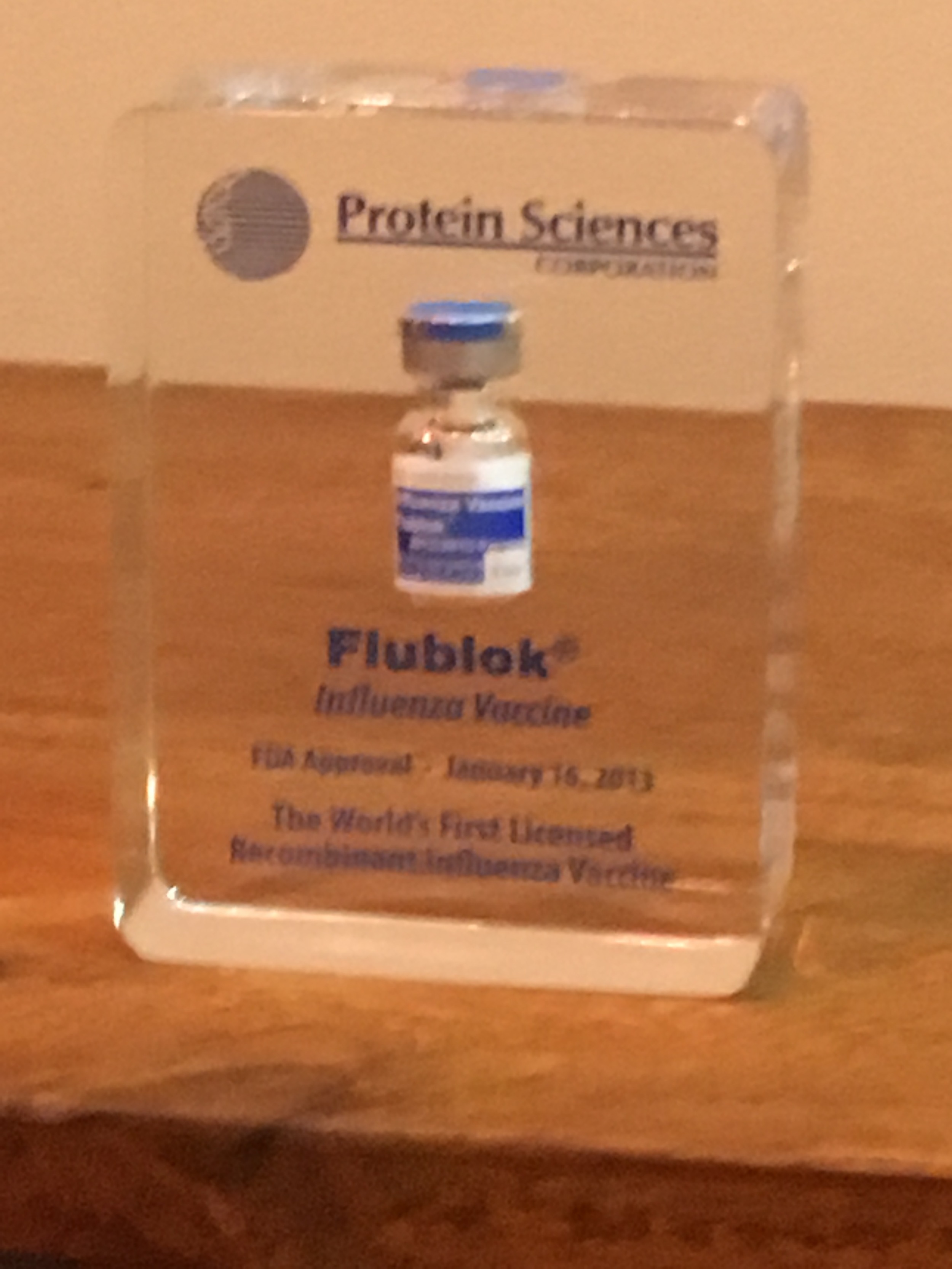
A Field Trip Fit Only For an Infectious Disease Nerd: A Flu Vaccine Plant

A couple of weeks ago, I had the pleasure of taking the ultimate nerd field trip. Where did I go?  To an influenza vaccine plant, naturally. This was no ordinary vaccine plant I got to see though, it belongs to Protein Sciences Corporation: the sole supplier of the only recombinant influenza vaccine, Flublok

I am someone who has been a critic of the ordinary flu vaccine for myriad reasons, chief among them are its poor efficacy and the cumbersome and snail-like manufacturing process. These two deficiencies will spell doom in the face of a flu pandemic when speed, adaptability, and high efficacy could crucially alter the trajectory of the viral spread. Recombinant vaccines, not reliant on chicken eggs, fulfill these criteria and, as such, they are the vaccines of the future (not just for flu, but possibly for many other infections). 

Currently, the FDA has approved a 3-strain version of Flublok for use in adults. Many people, however, believe Flublok to be the vaccine of choice for those with severe egg allergies -- which it is -- and fail to realize there are more reasons to possibly prefer this vaccine over other options.

There is a growing body of data, for example, showing that this vaccine, in a yet-to-be-approved 4-strain form, provides superior protection when compared to the ordinary vaccine. "So what?" you might think, "4 is better than 3 and there is no 4 strain Flublok yet." Indeed, that is what I thought until I studied this vaccine in more detail and realized that its superior perfomance was due to something that nullifies the above argument.

Its advantage is its ability to ward off the tricky-to-grow H3N2 A strain included in both 3 and 4 strain vaccines; not the extra B that is included in quadrivalent vaccines. Remember, since Flublok is a recombinant vaccine there's no growing in chicken eggs and, consequently, no mutations that occur during growth creating a difference between what strain was used to construct the vaccine and what ultimately hatches at the end (such differences are likely a cause of diminished protection seen with the routine vaccine). Additionally, Flublok contains 3 times the amount of antigen per strain than the ordinary vaccine which also may play a role in its potency as does its ability to stimulate antibodies that are more broadly protective (against the hemagglutinin stalk in addition to the globular head). Overall, this approach has very high biological plausibility and I anticipate clinical studies will soon be published that definitively confirm these findings.

Flu is the big beast, the infectious disease I fear most. This flu season I might try the vaccine of the future.


Pantoea of the Cotton: Cotton Fever

This week I was consulted to see a patient that was, for an infectious disease physician, fairly routine: an injection drug user with a fever. However, this injection drug user had some particular habits that were interesting and the key to her diagnosis.

She had the usual fever, chills, and muscle aches that are characteristic of a bloodstream infection. She also complained of back pain leading to the suspicion that the infection could have seeded her vertebral column. She had a markedly elevated white blood cell count suggesting a large immune response had been immobilized. An MRI, blood cultures, and echocardiography all ensued. The patient, however, rapidly improved from her initial state and all these studies turned up no answers.

The patient's peculiar behavior I referenced above (and it might not be all that peculiar) was that she, when out of heroin, would attempt to draw up any remaining heroin from cotton she had used in the past to draw up heroin. Cotton is used as a crude filter and her hope was that small remnants of heroin might remain in the cotton and be dislodged into her body if she injected through it. This reminds me of a David Sedaris short story in which he is scouring his carpet for crystal methamphetamine specks. Despite using clean needles, there are other risks that injection drug users often fail to appreciate.

She had cotton fever. Cotton fever is the result of a bacterial toxin produced by the bacteria Pantoea agglomerans which colonizes cotton plants. What occurs during cotton fever is that residuals of the endotoxin are injected along with the heroin remnants. The endotoxin stimulates a substantial immune response triggering intense symptoms but no bacteria is found as this is pure toxin-mediated. Of course, blood cultures and antibiotics should be administered initially as it is difficult to predict if viable bacteria were also injected along with the endotoxin.

Injection drug users present myriad challenges, cotton fever may be one of the more interesting.

The Panic Virus: A Book With No Expiry Date

Yesterday I finished Seth Mnookin's acclaimed book The Panic Virus: The True Story Behind the Vaccine-Autism Controversy.  I am not sure why I postponed reading this book that was published in 2012 and now wish I had it read it earlier when I was heavily engaged in defending vaccines during the Disneyland measles outbreak. 

However the lessons of the book are still highly relevant to me and to the discussions I often find myself in. For instance yesterday, coincidentally, I found myself back in the same position defending the power of vaccines (this time HPV) against an onslaught of murky anecdotes, hearsay, and outright falsehoods. On such battlefields, the weapons of logic and reason can sometimes have no effect on those impervious to rational discussion based on facts. The Panic Virus explains why such a phenomen occurs. 

The chief value of this book, to me, is not that it details the history of this spurious, erroneous, and damaging smear against one of the most important life-enhancing technologies discovered (which it does), but that it delves into how such a false notion took hold, was promoted, and enabled. Published 4 years ago, The Panic Virus is still probably the best book in its field for this very reason.

A person's receptiveness to and acceptance of ideas is not automatic and, ideally, requires careful thought as to if what is being proposed as fact integrates with the sum of one's whole knowledge. A process of rational deliberation is required for an idea to be accepted as true. As such, logical thinking -- in which contradictions cannot exist -- is essential.

What lies at the root of the irrational fear of vaccines is what I believe is pure emotionalism and a disdain for reason. As Mnookin writes:

“But when it comes to decisions around emotionally charged topics, logic often takes a back seat to what are called cognitive biases—essentially a set of unconscious mechanisms that convince us that it is our feelings about a situation and not the facts that represent the truth”

Without logic, any arbitrary assertion is given a cognitive status it does not merit and impossible discussions about proving a negative ensue. If causal scientific data is considered to be equivalent to contextless correlations, anecdotes, and Jenny McCarthy's "mommy instinct" it is clear which side gains and which loses. It is especially egregious when those arguing with such overt fallaciousness are left unchallenged and regard science as just another way of "knowing" no different from rank mysticism, to which emotionalism ultimately has to degrade to as evidence is eschewed and evaded in favor of "intuition".

The Panic Virus is a book that defends not just science, but rationality as such. In Mnookin's inspiring closing of the book he harkens for a world:

“where science is acknowledged not as an ideology but as the best tool we have for understanding the universe, and where striving for the truth is recognized as the most noble quest humankind will ever undertake.”

I do too.


Zika Owns 1 Square Mile of America

By now, everyone knows there are 14 cases of local mosquito-borne transmission of Zika in Florida, some symptomatic and some asymptomatic. What is interesting about this small, and completely expected, outbreak is that it is, thus far, seemingly confined to one specific neighborhood of the city of Miami (in Miami-Dade) called Wynwood. This conglomeration of cases has caused the CDC to issue a travel advisory for pregnant women traveling to just that neighborhood of Miami which spans about 1 square mile. 

That this first documented outbreak of Zika within the 50 states is hyper-localized comes as no surprise as the Aedes aegypti mosquitoes responsible for the spread of the virus are not big commuters, preferring to stay around 150 meters from where they hatched. Also, neighborhoods have differing capacities for supporting mosquitoes in terms of ready access to blood meals and ample standing water for breeding. 

This hyper-locality made me recall a conversation I had months ago with a top Mexican public health official who lamented his entire country getting slathered with Zika-colors and a travel advisory when it was truly a specific region that was conducive to Zika spread.

The CDC, by sticking to real-time date and the evidence, was able to issue -- for the time being -- a very specific travel advisory so as to delimit panic and derail an economy heavily reliant on tourism. This type of highly actionable and precise advisory should be the norm (when possible).

Interferon Gamma: A Social Lubricant that Packs a Pathogen Punch

I've written before about the extremely fascinating link between the immune and nervous system, hypothesizing about such interactions having a role in "sickness behavior". Such behavior may cause someone ill to not feel up to participating in social interaction thus delimiting spread of a potential contagious disease. 

There is no doubt that social interaction fosters the spread of infection. In fact, the rise of large settlements (proto-cities) changed the infectious milieu our ancestors faced as the transitioned away from a nomadic hunter-gatherer lifestyles. In cities, social interaction is the norm and it presents a constant challenge to the immune system as it faces a heightened exposure to microbes from other humans, some of which can be deleterious if allowed to proliferate.

So if social interaction is unavoidable, how does one protect oneself. Vaccinations, hand hygiene, social distancing, and cough etiquette are all fairly recent developments. Before these technologies, humans had to cope on their own and those evolutionarily endowed with a coping mechanism would be favored. 

New research published in Nature, helps flesh out this "inflammatory reflex" a little more. A group at the University of Virginia has discovered that the molecule interferon gamma -- a well characterized means organisms use to fend off pathogens -- is intimately linked with social behavior. To oversimplify, when one is in a social context interferon gamma increases so as to protect one from the microbes one will face from others. When the molecule is blocked in mice, social interaction decreases.

The implications of this research are far reaching and may lead to further investigation of how interferon gamma may influence pathological social deficits.