
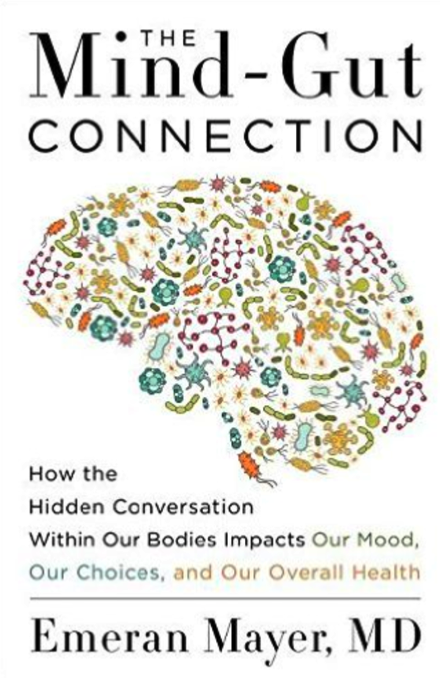
The Real Axis Powers: The Brain, The Gut, and The Microbiota

The last few years have seen a plethora of books published on the microbiome and the related topic of the influence of how the gastrointestinal (GI) milieu has implication that reach far beyond one organ system. I recently finished another book in this genre, The Mind Gut Connection: How the Hidden Conversation Within Our Bodies Impacts Our Mood, Our Choices, and Our Overall Health by UCLA gastroenterologist and professor and Dr. Emeran Mayer MD, PhD. The focus and theme of this valuable book is on the intricate relationships the enteric nervous system (ENS) has with the brain and how alterations in this second brain are increasingly being linked to myriad conditions. 

While the ENS gets much less attention than the brain and spinal cord, which together comprise the central nervous system (CNS), it is no less important and Dr. Mayer's book concretizes this fact in countless ways. Beginning with hypotheses regarding the signaling molecules that evolved between ancient bacterial species, when they were the only organisms to "talk" to on the planet, Dr. Mayer moves to the multicellular but tiny marine creature, the hydra, which is described as "a floating digestive tract". Eventually organism like the hydra were colonized with bacterial species and a symbiotic relationship evolved. Fast forward to our gut, minutely wired with nerves and teeming with neurotransmitters like serotonin, and you can understand how this system developed. As Mayer argues, as the primary brain evolved and  the role of the secondary brain was relegated to the GI tract with an important connection between the two via the vagus nerve which allows constant communication and feedback. The microbes in the gut are a vital component of this system as well as their metabolites directly interact with the ENS and, consequently the brain. 

To put it simply, there's a clear physiological and evolutionary reason why one gets diarrhea when nervous as a full bowel may not be the best thing to have when facing an important stressor like a lion (or the SAT exam). Taking this simple example and expanding it to reveal how perturbations in this system can lead to real pathology has led to major insight into diseases as disparate as celiac and Parkinson's disease.

There are many fascinating aspects of this book including historical observations (via a gastric fistula) made on how various emotions influence digestion rates, the role of inflammatory foods, and how psychosocial stressors (particularly early in life) can leave their mark on the gut-brain-microbiota axis. This book stands out in this ever growing field as one that provides a lot of seminal information about the ENS and the microbes it interacts with in an easily accessible manner with an emphasis on explaining real world macro-phenomena and it is for that reason I highly recommend it. 


Viruses, DNA Cages, and Tigers, Oh My! A Review of Tiger Tiger

In a world in which daily headlines announce breathtaking advances in genetic engineering and synthetic biology that have the promise to eradicate disease and lengthen lifespans, it is not surprising -- and actually prudent -- that there efforts to understand how such technology could be misused. So called, dual use research of concern, is not something that is specific to biologic advances it applies to literally everything. Any technology can be misused from a drone to a fishing rod. However, it is the threat of bioterrorism coupled to rapid advances in biology that have motivated much concern and debate. Naturally, this debate has spilled into popular culture with a planned television show centered on the gene editing technology CRISPR in the works and several books, including a fiction thriller I just finished.

Tiger Tiger, the second novel in author Joann Mead's Underlying Crimes series of bio-thrillers, is the story of a biological attack on the United States and efforts to stop it. This attack is not accomplished using the usual suspects of anthrax, smallpox, plague, or botulism. It is accomplished using engineered influenza viruses -- inspired by the controversial influenza gain-of-function experiments -- for which there is no vaccine readily available. The perpetrator of the attack, an overtly nihilist philosophy professor, seeks out unscrupulous and disturbed scientist from whom to purchase these tiger influenza viruses which are derived from strains that had caused an outbreak in zoo tigers (something that has really happened). The delivery system for these viruses is no crop-duster by DNA molecular cages -- a major advance in nanomedicine.

The plot oscillates between the nefarious actors attempting to initiate their attack and the efforts of a secret group of government agents and other experts (the Partners)  to discover what is occurring after the first test infections are "successful". As they race to unravel the etiologies of these infections in order to stop them before a bigger wave of infection occurs, Mead emphasizes how open source intelligence gathering from social media, for example, can be harnessed in such endeavors as her namesake character run down various clues.

I enjoyed reading the book, less for its literary value (and multiple unusual sex scenes), than for its presentation of how a bioterrorism attack might look in the world of nanotechnology, CRISPR and synthetic biology. When it comes to these technologies, I view them as pathbreaking technologies with enormous value that far eclipses any potential downside from improper use -- which isn't as easy as it might seem in a novel, a movie, or a government report. I also enjoyed a science-driven plot that was not completely fantastical and well-informed by the actual issues, the science, and the technology of the day.

The theme of Tiger Tiger may be the relative ease with which a bioterrorist attack can be executed and the increasing realization of that fact by those who would seek to do harm -- something which almost everyone in my field would agree is true.


Cats Beware: Eating Tweety Bird May Be Hazardous to Your Health

Though buried among Christmas season headlines, the report of a veterinarian contracting an avian flu strain from a cat is, to me, highly significant. When people speak of avian influenza viruses it is the highly lethal H5N1 or H7N9 that are being discussed as these two viruses are high on many threat lists. 

In this incident, a New York City veterinarian caring for sick cats contracted the H7N2 virus which had not been known to infect cats before this event. It has been speculated the cat may have contracted it from a pigeon. It had been diagnosed in humans at least twice since 2002: once from someone involved in a Virginia avian outbreak and once before, interestingly, from a person in New York City without an unknown exposure. The veterinarian, like the two other human cases, recovered uneventfully and no secondary spread of this virus to other humans was detected via a robust surveillance operation conducted by the New York City Department of Health. 

This event, to those who track influenza, transcends the minor illness that results as it is an important example of how zoonotic flu viruses could take hold. These types of incursions into new species are important to study and the viral characteristics and changes that made such a jump possible should be compared to wild-type viruses that circulate in avian species. 

Influenza possesses many capacities that bestow it with the the capacity to cause cataclysmic (no pun intended) pandemics. Among these capacities, its ability to infect a variety of different types of animal species and shuffle viral genes inside them is probably the most valuable. Moving from birds to cats to humans is one such example. Indeed, the pandemic H1N1 virus has a complex genealogical origin that is a triple-reassortant virus that reassorted again. When a virus has a wide host range, it can take all sorts of turns and jumps some of which may lead to a human pandemic. These types of events can be predicted but the precision may not be perfect as our last pandemic emerged, not from China, but from Mexico.

While there has been a much needed focus on H5N1, we also know that H7 (H7N2, H7N3, H7N7, H7N9) flu viruses have an ability to jump into humans and, in the case of H7N9 cause severe disease. I wonder if the fact that multiple H7's have been making incursions into humans is a sign of what our next pandemic flu virus may be. Thus far, it appears the most prolific of these H7's, H7N9, has not changed substantially through its 4 waves of infection

While it appears that, fortunately, H7N2 does not lead to severe disease in humans this event should remind people of the prowess of flu viruses and the eternal vigilance needed to protect the human race from this extremely successful virus.

A Key to the Realm: My thoughts on the Anthropology of Infectious Disase

One of the reasons why infectious disease as a medical speciality has so much more allure, to me, than all other aspects of Medicine is that it is explicitly connected to many facets of the world. A person's social history -- what they do for a living, who they do it with, where they travel, their habits, their pets, where they live, and their hobbies -- all condition what microbe they encounter and whether that microbe can damage them. 

In short, the anthropology of infectious disease is a crucial, intellectually stimulating, and fascinating aspect of infectious disease. University of Connecticut Professor Merrill Singer's recent book on the topic, simply entitled Anthropology of Infectious Disease, provides a comprehensive tour of this topic, providing an important grounding for anyone who has an interest in understanding infectious disease.

Why did botulism surge in the republic of Georgia after the fall of the Soviet Union? Why did kuru proliferate and then vanish? Why do certain prisoners traffic in tuberculous sputum? All of these questions can be answered through the lens of anthropology.

As Singer notes, 

Infectious diseases are never only biological in their nature, course, or impact. What they are and what they do are deeply entwined with human sociocultural systems, including the ways humans understand, organize, and treat each other.

The anthropology of infectious disease is the arena of applied and basic anthropological research that focuses on the interaction among sociocultural, biological, political, economic, and ecological variables involved in the etiology, prevalence, experience, impact, cultural understanding, prevention, and treatment of infectious diseases.

This book concretizes, through myriad examples, the many ways in which an infectious disease's proximate causes are, in an anthropological context, secondary to distal causes in, as Singer puts it, an "ecological web of causation." 

While I may take issue with many of Singer's political leanings and assumptions, especially his conflation of political equality (which I champion) with economic "equality" and poverty and his de-emphasis of biosecurity, the book does provide a comprehensive overview that provides the reader with a fuller context, or an essential key, for understanding the realm of infectious disease.

Zombie Spiders, The Emotion of Disgust, & Parasite Stress: My Thoughts on This is Your Brain on Parasites

in what is a trend in my list of books I read, I just completed another which deals with the host-parasite interaction from the angle of how parasites influence behavior: This is Your Brain on Parasites: How Tiny Creatures Manipulate Behavior and Shape Society by Kathleen McAuliffe. 

The aim of this extraordinary book is to explore the many ways in which parasites, with a view to their own reproductive success, change behavior in the species they infect. This ranges from very subtle perturbations to seismic shifts. McAuliffe expertly provides multiple examples from varied species including zombified spiders to sexually-charged rabid dogs to insights into human psychiatric disease. Her discussion of the emotion of disgust and its potential origin and usefulness when it comes to parasitical infection is enlightening as is her discussion of the origins of vampire myths.

Another fascinating aspect of this book is its probing of the characteristics of high parasite-burden human societies. While causation is difficult to establish -- nor maybe even valid in such a context -- the correlations produced are extremely interesting. The "parasite stress" a country, community, a village, a people, or region faces has a high correlation to their view of immigrants, their views on gender issues, and a tendency to dictatorial-style governments. This last is an extremely important finding and something I think deserves further exploration. Parasite stress, the way I conceptualize it, not only may have subtle direct behavioral consequences but also will tend to create a poverty trap for the infected, stifling opportunities for economic activities necessary for flourishing and ripening the prospects for dictatorship to rise in an environment in which challenges are not feasible as people stick to their clans and deal with the onslaught of infectious disease.

The lines of inquiry in this book are very intellectually stimulating and do not undermine human volition. Human free will is axiomatic however alterations in cognition can occur for a variety of reasons, some of which may be parasitic in origin. For example, the prevalence of toxoplasmosis in certain psychiatric conditions cannot, based on its pathophysiologic characteristics, be purely coincidental.

The book is highly recommended.