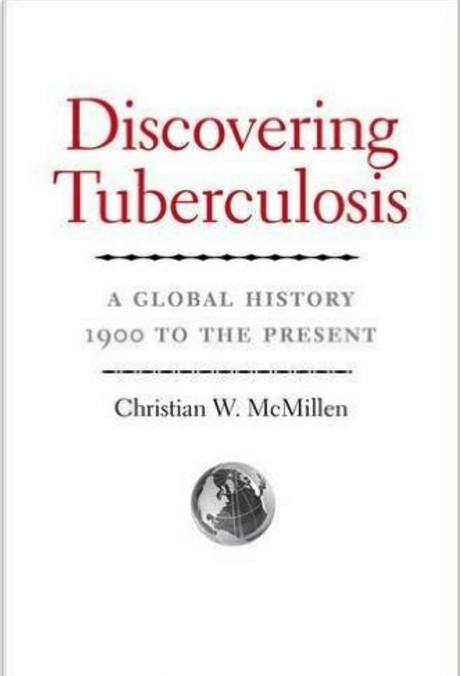
Rediscovering TB: A Review of Discovering Tuberculosis

The single microbe that kills the most humans in 2016 is not Ebola, not Zika, not brain-eating amoebas. It is not an infection that continually grabs headlines. It is Mycobacterium tuberculosis, a profligate killer that has menaced humans since our appearance on the planet. In 2014, tuberculosis felled 1.5 million humans.

There are many books about very aspects of tuberculosis that I have read but none of them have really attempted, in my recollection, to tell the story of tuberculosis with an aim to make the history of our species' battles with disease relevant to the present. That lack of present-centrism is no more with UVA History professor Christian McMillen's Discovering Tuberculosis: A Global History 1900 to the Present.

Discovering Tuberculosis is a scholarly work that takes the reader through several important phases in the control of tuberculosis with attention to the principles at play in each of them. From efforts to control TB on Native American reservations to the global fight against HIV/TB coinfection, McMillen skillfully makes the past not just come alive but completely inform how we presently face this infection.

Some important highlights of the book include the failure of the BCG vaccine and how this vaccine may have stymied vaccine development more generally; the early harbingers of the threat of drug resistant TB in 1960s Kenya; the vicissitudes of the approach to HIV/TB coinfection, and the not often mentioned negative effects of directly observed therapy.

One of the most important aspects of this book is that it relies on Professor McMillen's extensive review of the actual communications between programmatic leaders and health agencies. Such a level of granularity grounds his analysis in the actual medical debates that were occurring, allowing almost direct application to current efforts.

Discovering Tuberculosis allowed me to gain a better understanding of today's global anti-tuberculosis effort and grasp how difficult it will be to rid our race of its most astute infectious disease killer. I highly recommend it.

A Pilgrim, A Saracen, and a Biothreat: A Review of I Am Pilgrim

If you were to get in the mind of someone in the biodefense field and amalgamate every horrible bioterrorist scenario that exists there you might come up with something like that envisaged by Terry Hayes in I Am Pilgrim. This 2013 book expertly weaves together standard espionage and law enforcement motifs with the possibility of bioterrorism. The bioterrorism act contemplated by the antagonist of the novel is no ordinary act, but one that would be positively cataclysmic, but not in an artificial way. The nefarious plan devised by Hayes's villain, known throughout most of the novel as The Saracen, is plucked right from real biosecurity concerns that derive from real scientific knowledge and experiments. In fact, Hayes integrates threats from synthetic biology, vaccine strategies, with weak pharmaceutical supply chains -- all topics of real concern in the field.

The plot of the novel is centered on a retired covert agent called back into action to stop an adversary to whom the "thinking enemy" label so often used in biosecurity discussions is a gross understatement. Overcoming his own personal conflicts, The Pilgrim, an expert forensic investigator, pieces together scattered clues in a methodical manner in order to zero in on his target. Throughout, and this may be the theme Hayes constructed his plot around, family ties between villains, minor characters, the protagonist's allies, and the protagonist are given strong emphasis and shown to be strengths and weaknesses depending on the context. 

I enjoyed, and was entertained, by the book for many reasons that went beyond the biosecurity setting of the novel. It is an exciting read. However, I do take issue with the ability of the protagonist's prowess with synthetic biology which he employs to synthesize a virus from scratch and endow it with vaccine-resistant traits. As has been thoroughly analyzed by Kathleen Vogel such feats are much more involved than just simply following a recipe. Tacit knowledge is not something easily obtained and, in fact, may preclude laboratory feats accomplished in one laboratory from being replicated in another with equivalent technology. That is not to diminish the very real simplification that has occurred in the realm, but science is still hard.

The book is soon to become a film and I am sure I won't be the only one in my profession seeing how biosecurity plays in Hollywood.

Repurposing Drugs to Fight Zika: Putting it into Context

Bursting through the almost continual parade of negative Zika headlines was news that 3 drugs -- one of which (niclosamide) was once FDA approved for another indication have the potential to combat this virus and its severe complications. This study was done in vitro in a laboratory setting and is unequivocally promising. The discoveries center on two drugs with antiviral effects and one which acts as a neuroprotectant. However, as I elaborated on in this interview with Healthday, there several important questions and caveats needed to put this finding in the proper context, two of which I discuss below.

1. In vitro needs to become in vivo: The most obvious next step to be taken with this finding is to see if it holds up--and provides a clinically meaningful benefit--in animal models. Can effective doses be achieved? How robust is the response in an animal model? Do they cross the placenta? Are they safe in pregnancy (at least niclosamide is)? These are the types of questions that would be pursued with an animal model and provide an ability to gauge the feasibility of these drugs as actual treatment options.

2. Concept of Operations: Anytime a new countermeasure is being evaluated for its use in the treatment, prevention, or control of an infectious disease the use case for how it is to optimally used must be part of the discussion. With Zika, an antiviral strategy is difficult for several reasons including, chiefly, the fact that the vast majority of people do not know they are infected and therefore wouldn't be prompted to seek treatment. Secondly, Zika is largely a fleeting virus that comes and goes and in that short process, in certain circumstances, causes fetal harm in pregnant women. Can pharmaceutical intervention occur quickly enough?  Can these compounds make an actual impact on complications? 

If I were to think of a possible concept of operations it would have to center around using these drugs prophylactically to prevent or blunt infection -- if the drugs have that ability in vivo. For only with high drug levels in one's body pre-infection could one have a good chance at preventing the virus from taking hold, spreading to the fetus, or causing other complications like Guillain-Barre Syndrome.

Overall, the repurposing of existing drugs in the face of an emerging infectious disease outbreak is a major effort that provides the fastest path forward to developing new countermeasures. This is especially true if the drug being repurposed has already been FDA approved for another indication such as niclosamide was. When an already approved drug can be used "off label" for a new clinical problem, the burden of funding large clinical trials and complying with FDA regulations is substantially lower.

Until a vaccine is available for Zika, it will be worthwhile to explore potential uses of antiviral therapy but building a concept of operations in which these compounds can be used optimally is essential.


The Red Queen & Pneumococcus

What does Alice in Wonderland have to do with infectious disease? It's not the risk of contracting tularemia from the rabbit but it's a very important quote from the Red Queen. Her statement below to Alice provided the basis for an important hypothesis.

"Now, here, you see, it takes all the running you can do, to keep in the same place."

This statement about Wonderland was taken up evolutionary biologist Leigh Van Halen to formulate the "Red Queen Hypothesis". According to this hypothesis, species constantly evolve to adapt to a world teeming with other evolving species just to keep up and survive, let alone reproduce.

Important evidence that illustrates that the Red Queen Hypothesis is more than a hypothesis was recently published in Clinical Infectious Diseases and revolves around the introduction of pneumococcal vaccines for children. Pneumococcus causes many important infections including those of the ears and sinuses as well as pneumonia. In 2000, the 7-valent version of the pneumococcal (Streptococcus pneumoniae) conjugate vaccine was released and became a universal vaccine recommendation in the US. The 13-valent version supplanted the 7-valent formulation 10 years later (Prevnar). Shortly, thereafter infections from non-vaccine types began to become more frequent, i.e. serotype replacement occurred.

This phenomenon led to discussion focused on whether "Red Queen dynamics" were at play. A new study provides fascinating evidence of the Red Queen's insight at work. In this study, conducted in Utah, specimens from 641 children who were hospitalized with invasive pneumococcal disease (IPD) between 1997 and 2014 were studied.

The results are striking. Not surprisingly, once the vaccines were introduced serotype diversity increased as serotypes that were, pre-vaccine, outcompeted by other serotypes got a chance to cause infection as the big 7 (and the big 13) were rendered obsolete, alone in a world that was too vaccinated for them to flourish.

However, after a period of time, that diversity decreased as certain serotypes began to dominate others and became the main causes of IPD in the post-Prevnar era. What transpired was the establishment of a new evolutionary paradigm in response to changing world conditions that came in the form of potent vaccines that brought about a great culling of the pneumococcal species. Ever resilient, the pneumococcus quickly adapted, on the species levels, to this new normal.

Serotype replacement and Red Queen dynamics make vaccine development a very difficult proposition when there is a pathogen swarm waiting for their turn to wreak havoc. 

Heroes Never Die: A Personal Tribute to DA Henderson

This is a post I never wanted to write.

Dr. DA Henderson, the man who eradicated smallpox from this planet, has died. There are no words that can do adequate justice to this benefactor of humankind whose genius and ingenuity will be known for millennia. I write as one of the extremely fortunate individuals who can call DA not just hero but mentor.

I first met DA about 8 years ago as an infectious disease fellow. I can still recall my sheepish uttering of "Dr. Henderson" when I met him in his office as he sat amongst innumerable awards commemorating  the incalculable debt humankind will owe him in perpetuity. DA, despite my naivety, thoroughly embraced me in a way reminiscent of  the manner of a grandfather -- if your grandfather was a man who slayed dragons for a living. I am sure I am not unique in this feeling about DA as there are scores of his mentees worldwide who likely have similar sentiments.

DA was a force. He was someone who would never, ever, balk from calling a spade a spade. However cliched the phrase "speaking truth to power" may be, DA exemplified it. One of my first glimpses of this unrivalled ability of his was during the 2009 influenza epidemic where, just upon hearing preliminary information regarding its trajectory, he had its number. Incidentally, during that pandemic he and I coauthored a piece inspired by his recollection of the concept of antigenic sin---which I believe will be the highlight of my career. During this pandemic, DA was wont to add insightful suggestions as well as pointed criticism when warranted.

During Ebola in 2014, again DA showed his prowess arguing that directing control measures against those who were most contagious made the most sense in quelling the outbreak (another paper I was lucky enough to coauthor with him). 

Time and again, DA was proven right and his insight steered infectious disease medicine in a unique manner in which no one else could. 

In DA's last days, another of my mentors--Dr. Tom Inglesby--called me and told me to visit with DA as he really wanted to talk about infectious disease. I am eternally grateful to Tom for that call as my last visit with DA is something that I will never forget. What did we talk about? Here are two statements of DA made during our last discussion:

"What virus do you want to talk about next?"

"What other puzzles are there?"

These two statements from DA exemplify all that I want to be in my life-- someone so passionate and dedicated to productive work in my field that nothing refrains me from engaging in discussion about it, despite any circumstances I find myself in. The devotion DA had to his work, his ideas, and his mind is something unfortunately all too rare in the world today.

There are many recollections I have of working in the same office as him. Gone are the days when I can walk down to his office and hear him dissect the latest outbreak offering glimmering pearls as to what he determined to be the trajectory and implications of this latest insult on the human species -- something that continued up to and including Zika. But this impact is even more profound as the entire world counted on DA's wisdom to set the course of its battles against myriad infectious diseases from polio to guinea worm.

I heard that DA's health took a final turn for the worse as I was about to give a lecture on biosecurity, a field he was basically the founder of and who conceived of and founded the center of which I am a member. His leadership during the anthrax attacks of 2001 made the nation, and the world, safer and more prepared for bioterrorism than it ever had been. The ripple effects of his leadership will echo for decades. As I spoke, I suppressed emotions I had about a man who indelibly affected me and whom I knew I could never repay. 

If there were a Valhalla, I would like to imagine Pasteur, Koch, Lister, Salk, Sabin, Theiler, Ross, Semmelweis, Jenner, DA's mentor Alex Langmuir and the pantheon of the infectious disease luminaries, to whom the human race owes so much, on their feet, clapping in unison to welcome the man who took their ideas to their logical conclusion and rid mankind of an infectious scourge rendering it incapable of harming a human again.

I will never forget all that DA taught me and will always try to live up to the example he set. I will never cease regaling people with the stories of his life and achievements as they serve as an inspiration for what one human can aspire to be. 

What would DA do (WWDAD)? If that were to become the reigning paradigm in our field, I would surmise the human race would do just fine.

He not only tracked the zebra, he conquered it.

Infectious disease has lost its commander-in-chief.